Pages

Showing posts with label politics. Show all posts

July 29, 2011

close to home


A week ago, Norway had a devastating tragedy happen to them. For me it brought to light that even countries as far north as Norway have issues and conflicts with immigrants and multiculturalism. Secondly, it was a reminder that a madman will kill until no one is left. There is clearly, though, a larger issue at hand. That was apparant when I learned that the killer was captured and did not kill himself. He wanted to start a revolution against multiculturalism.

It’s an idea that is not far from Nazi ideals. In America it’s not far from the modern day KKK and neo-Nazi movement. Luckily, these groups have not created such carnage in years. I think there is a much more frightening thing going on right now in America that is really not that far from what happened in Norway.


In places like the state of Arizona they are creating laws to do almost whatever they can to keep immigrants out. In NYC the city is divided over whether to let a Mosque be built near the site of 9/11.  And all over the United States people have a similar hatred (a strong but accurate word) for immigrants and Muslims (among others). This really isn’t a new attitude. However, the extreme or counter-cultural ideas are now becoming more mainstream and normal. A quote from a normal “Christian” on Facebook:  
  
“If you cross the N. Korean border illegally, you get 12 yrs. hard labor. If you cross the Afghanistan border illegally, you get shot. If you cross the U.S. border illegally you get a job, a driver's license, food stamps, a place to live, health care, housing & child benefits, education, & tax free business for 7 yrs. No wonder we are a country in debt. Repost if you agree.”
There are a couple alarming ideas in this post. First, it’s stating that the debt problem is coming from the over abundance of illegal immigrants. Ironically, illegal immigrants have been providing cheaper services at hotels, restaurants, and the like for years.  The same capitalism these “legal” citizens believe in has only created a space for cheap illegal labor over American labor. The idea of debt is also a jab at the Democrats, which as the NYT has pointed out is less of a Democrat problem and more of a Bush era problem of cutting taxes to only the rich and many years of war – two things Republicans keep endorsing as good things. It’s also sad to think that people have forgotten just how bad it was during the Bush era (also proved by the NYT graph) and how much damage was caused especially to the economy, and yet still think Bush is a saint compared to Obama.

Second, this Facebook post is endorsing the idea of killing people for being immigrating illegally. The idea is not far from those of the tragedy that happened in Norway not 4 weeks afterward. This person - perfectly “normal” - is saying that the death of people is better than life. The ideas of the United States used to be far from this of course. Just take a look at a quote on the Statue of Liberty: “Give me your tired, your poor, your huddled masses yearning to breathe free.” For many American’s this no longer applies. It was nice when white Europeans were immigrating, but now that it is mainly immigrants from places like Mexico the same attitude does not apply.

That isn’t to say that some type of immigration reform isn’t needed. I’m just not sure death is the answer. Unfortunately for us the Norway killer’s idea of revolution has already started without him. I’m sure this person on Facebook would still post the their message and would want people to repost it.   I am equally as sure that this person – and the many who agree - would also like the U.S. to default on their credit to pay for their bad spending habits.  Habits that, again, ironically don’t come from the current president, but from the Republican president before him who spent billions on national defense while cutting taxes only for the rich and corporations. For the rest of us, we can only hope that the killer’s revolution raises an alarm about the importance of valuing all people. 

July 6, 2011

hot election

With the summer heat upon us I thought I would bring some hot topics to today’s blog – the election. I’ve broke it down into topics in three segments on why I think and don’t think Obama will be re-elected. I don’t really understand the American public and much of its voting practices, but it’s fun to think I do.

Why he might lose

ECONOMY – Lack of recovery and return on stimulus

At the beginning of November this may be the only point voters really care about. With an economy that’s been busted way before Obama has been office, it seems (to me) that the nation is looking for Obama to fix it. If the economy doesn’t improve a significant amount by Election Day I don’t think Obama will get re-elected. The days of Roosevelt economic policies are no good anymore. With the government’s spending at a max does anyone want the government spending more money for a recovery?

JOBS – Unemployment is still too high

If the economy doesn’t sink Obama in the election, jobs (and next on the list gas prices) will. Although unemployment is down, and the job growth is better than the job decline of his predecessor, the job market hasn’t improved well enough for the voters.

GAS PRICES – Remember when

It was okay to reelect a president when gas prices were high when the vice president was so influential in the oil business. Now with a recession it is just harmful. With no relief at the pump in a while, Obama can only hope that opening up U.S. oil reserves will help, not hinder him at the polls. Republicans? They are already blaming Obama for high gas prices just as Democrats were doing to Bush eight years ago.

FREEDOM – Fear of the red

Who really knows how many Americans think Obama is a socialist or communist. Various polls range from around 30% to anywhere around 55-60%. Considering he compromised to continue to give tax breaks to the richest in America that’s a very high number. Fear that Obama is a communist or works with many communists is one of many misconceptions that Obama’s administration has to deal with on a daily basis.

WARS/GUATANAMO BAY – Speaking of promises

One wave that Obama rode into his election was that he was going to end the Iraq war and close Guantanamo Bay. Iraq? It’s ending sometime, but much slower than anyone probably thought. Guantanamo? In a failed attempt it looks like Guantanamo will be staying open. What about Afghanistan?

IMMIGRATION REFORM – Kick them out… kick them out… all out!

In the end this topic won’t make or break many votes. For both sides though immigration reform hasn’t been changed or challenged. Anyone looking to vote solely on immigration reform may be upset at Obama. In the end though, Republicans don’t offer a better alternative.

THE ISSUES – just not getting done quickly enough

When you say you are going to bring a soda machine into the school you have to deliver. The hope and enthusiasm that Obama brought to many voters has left them upset at many things they thought would happen. Although he is the President there are still so many check and balances that you can’t blame Obama solely on not being able to deliver on all his promises. To see how Obama is doing on all his promises go here.

BAD PRESS – Who says any kind of press is good press

In 2006 and 2008 Democrats seemed to take control, and to me it looked like Republicans were going to struggle for a while. Not only did they do a complete 180ยบ in 2010, but have even created bad press to the masses leading up to the 2012 election. The Obama administration has not been able to combat all the bad press with many of the good things the administration has done to both independents and Republicans.

CHANGE - keep the change you filthy animal

People afraid that the Obama administration is going to take away their guns, money, and freedom have put on a full scaled launch against Obama. Ironically it has been the banks and other business that they have been deregulating for the past 30 years that have been taking the most money and freedom from them.

Why he just might win

COMPROMISE

One way to win is to compromise. I’ve seen Scott Brown do it in Massachusetts, and Obama can only hope that independents see that he can work with both Republicans and Democrats. Obama has shown considerable compromise in taxes, in a bi-partisan cabinet, and others. He really is a centralist, but nobody knows it.

DADT

It’s not going to change the outcome of the election, but the repeal of the ‘Don’t Ask Don’t Tell’ policy is a step that many Americans see as good.

START security treaty

The treaty with Russia shows that Obama can work with international leaders and work toward a nuclear free world.

AUTO BAILOUT – Vroom vroom

Republicans hate the auto bailout. And it’s not something you want to see a government do all the time. In the end though not only did the bailout save companies like GM and Chrysler, the many suppliers that work with those car companies, and the thousands families who depend on the car industry it actually was a good “business” move for the U.S. government who made money off of the bailout.

TEA Party

The TEA Party keeps growing in popularity. Unfortunately for Republicans the independent voters they are trying to sway aren’t swayed like TEA Party Patriot like Michele Bachman. The Republican Party, if it really wants to win the election, will have to have a more central candidate unless the Republican Party wants another debacle like the TEA Party Patriot, Christine O’Donnell in Delaware.

I’m on the fence

OBAMACARE

The fact that the new healthcare law has been coined “Obamacare” makes me think that it will hinder not help Obama’s election campaign. On the other hand there are many good things about the new law including:

1. Eliminate lifetime limits on insurance coverage
2. Prevent health insurance companies from denying coverage because of a pre-existing condition
3. Allow young adults to remain on parents' insurance until age 26.
4. Provide subsidies for individuals and families and are not covered by an employer to purchase their own insurance.
5. Creates healthcare exchanges for uninsured people to purchase coverage at competitive rates.
6. Gives people on Medicare new access to free preventive services such as screenings for cancer and diabetes.
7. Closes the "doughnut hole" gap in Medicare Part-D by 2020.
8. Slows spending increases for Medicare beneficiaries to 2% per year, from the current rate of 4% a year.
Of course many of these changes won’t take place until after 2012 election which makes many of the good things about the law unsubstantial to voters.

What won’t matter

Reagan’s poor economy verses Obama’s poor economy. Some think that because Reagan won with a poor economy that Obama can do the same. It was a different era and a different mood of the country. I don’t think people can depend on this comparison to think that Obama can win.

A face to the Republican nomination. As of yet, there is still no strong face to the Republican Party. The people who are going to determine the election don’t care if there is a face or not. They want the best person to improve their lives. And whoever presents the better case will win.

Osama bin Laden. It makes Republicans not question Obama’s leadership for about 3 seconds. Those 3 seconds are over. With the rest of the country it has had a bigger impact on the view of Obama. In the end, no one will remember this in the voting booth in November.

Other impacts

Besides the economy the outcome of congress voting on raising the debt ceiling in time or defaulting may have a huge impact on how voters view Obama. By the U.S. defaulting it creates a huge problem for the U.S. In terms of the election it creates animosity towards both sides of congress, but a bigger impact on the President.

Overall I still think the election is a wide open race as to who will win. Obama has a lot riding on the economy and gas prices. If they both don’t improve significantly in the eyes of American voters I’m not sure he can win the election. Sometimes disappointment, disapproval, and disdain bring out the most voters as we saw in both 2006 and 2008. I’m not sure Obama can depend on his supporters to come out even more as they did for Bush in 2004 to re-elect him. He will need to re-convince many of the same independent voters he won over back in 2008 to win.

June 28, 2011

We're #1

We’re number 37! We’re number 37! We’re number 37! Every four years the U.S. is able to chant “We’re #1!” during the summer Olympics. Let’s face it: the U.S. dominates the summer Olympics. It is easy to get caught up in American’s need to always be number one. Despite the recession and poor economy the U.S. is still ranked one of the best economies. Despite a car bailout GM has re-taken the #1 car spot over Toyota.

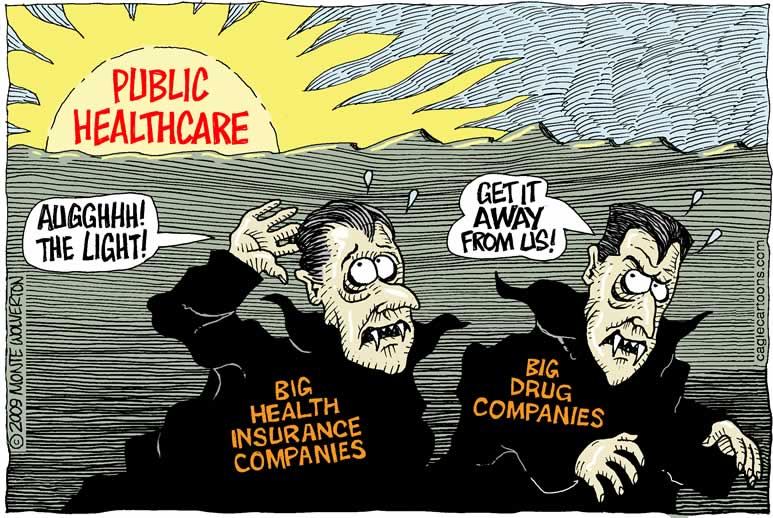
But, despite always having to be number one the United State ranks 37th in life expectancy in the world. Regardless of what Fox News would probably say we did not go from #1 to #37 when “Obamacare” was put into law. In fact, the new healthcare law is trying to combat some of the very reasons why we are ranked number 37.

In truth the U.S. does have some of the best healthcare in the world. The only problem is that it isn’t for everyone. It is easy to find these disparities. A quick look at the decline in cancer deaths in the U.S. is one example. Although cancer deaths are declining inequalities persist. Elizabeth Ward of the American Cancer Society, states “‘People of a lower socioeconomic status are more likely to smoke and less likely to get access to care where they can get screened for early detection.*’" Without giving everyone access to healthcare, including preventative healthcare, these discrepancies will continue and we can continue to chant “we’re number 37!”

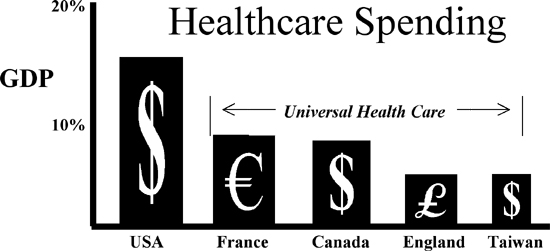
In the latest finding from the Institute for Health Metrics and Evaluations at the University of Washington it was concluded that in many parts of the country life expectancy is declining. Two of the biggest factors? Obesity and smoking. Although the U.S. ranks #1 in spending on healthcare, the way healthcare is done now its not reaching everyone.

Some are less likely to get cancer. Some aren’t. Some life expectancy is going up. For others it is going down. If we really want to chant “We’re #1” we need to make healthcare more comprehensive, accessible, and affordable for everyone. Not just the rich.

*June 17, 2011 article from NPR
Also check out the report from the U. of Washington.

June 15, 2011

food wars

Is the next great political war food? It’s not an ongoing issue like the economy, jobs, or war, but it may be the next big thing. As we’ve found out in the past two years not everyone in the United States wants every citizen to have quality health insurance or any at all. The problem of course is that in the end our tax money that has to pay for the care of people that can’t afford health insurance or quality insurance ends up costing us more in the end. A fact sorely neglected by many people. This same idea has shifted to the food wars.

I first took notice of the food wars when the First Lady, Michelle Obama, began advocating for food change and policy. The changes: the basic idea is nutrition education. Other aspects are providing better school lunches, farm-to-school school programs, less deserts, more food security, etc. This all sounds good to me. Apparently though this is infringing on people’s “rights” to get fat and have more heart attacks and cases of diabetes, the first and sixth leading causes of death in the United States respectively.

Former half-term governor, tv star, book selling, motorcycling, history expert Sarah Palin retorts to the First Lady, “get off our backs” in response to the Let’s Move program. I guess moving is too much to ask.

I’m not surprised by Sarah Palin and millions of others like her who are upset about the idea of better food programs and education to help people eat healthier. I’m surprised, because in a time where it seems cigarettes, something that was widely celebrated in the United States at one point in time, is widely attacked by city, state, and federal laws. Of course cigarettes are not illegal, but in many places such as restaurants, schools, hospitals, public buildings, and now even parks, parking lots are even banning cigarette smoking. Cigarettes are heavily banned in many places, there is hardly any advertising, it is taxed enormously, and it has wiped out the tobacco industry. And people on both sides of the line seem okay with it. Cancer awareness advocates can be proud.

Even more surprisingly to me is the idea that someone like Ron Paul can advocate that a dangerous drug such as heroin should be legal. His logic? Well, if we made it legal no one would use it. The same logic could be used for murder but we wouldn’t make that legal, would we? The government makes a drug like heroin illegal not to infringe on people’s rights, but to protect people from a drug that has damaging effects to a person’s brain as well as possible dangerous effects to family, friends, and strangers.

Doritos, McDonald’s hamburgers, and fried foods are never going to stop being sold. But it would be nice to educate people that a slice of pizza does not have a serving of vegetables, or that drinking a bottomless amount of soda or sports drinks is not good for people, especially adults. If initiatives such as Let’s Move teach children to eat healthier and help small farms bring food to schools - in turn helping the next generation to have less heart disease and diabetes - I’m all for it. Nutrition and what we choose to eat is vital to a healthy life style and the ways it affects our body for good or bad.

April 21, 2011

it's a race to the finish

I’m so excited! It’s that time of year again when we analyze why or why not someone should be president. I used to think that you had to have lots of money and political connections to be president, then Sarah Palin almost became Vice President, and my mind was forever changed about who the American public would/will elect.

The 2008 (or November 2007) election came down to McCain/Palin and Obama/Biden. I remember when they first announced Palin as McCain’s running mate. The buzz on McCain was huge – and for about two weeks I thought he might win. Then Palin decided to talk and have an interview with Katie Couric and the rest is history. I said it before here and still stand by it – I think if McCain had a different running mate such as Mitt Romney he would have won, even with the War in Iraq looming over the Republicans.

The 2012 election is a lot different for the Republicans. Much like how the Democrats swept through the house and senate in 2006 the Republicans embarrassed the Democrats in the 2010 House elections. There is no War in Iraq looming on the backs of the Republicans. Now, Obama has the economy on his back. This is what I think the key issue is: the economy. If the economy continues to improve, which includes jobs, the housing market, and lower gas prices I think Obama will win. If the economy continues to improve slowly like it is, I think Obama will not win.

Some analysts are already saying Obama has won this election while others say he has already lost it. I’m sure in the weeks and months to come we will see more photos of Obama with turbans and more accusations about his birth certificate, but let’s hope this election spends less time on that and is more focused on the issues.

March 19, 2011

slashing budgets, slashing ecology


With all this talk about slashing budgets whether it is on a national, state, or town level – public funding is taking a big hit. Why?  Well, simply so we don’t leave a huge gaping hole in our children’s children’s pockets. One problem with this thought though, or at least a bit of irony, is that many of the same people who are trying to reign in government and public spending are calling for the opposite in the way we look at our future ecologically.

And no, this isn’t just about greenhouse gases or wind turbines – although that is a big part of it. The way we are tearing apart the earth our children’s children’s pockets may be nothing to worry about if there is no land or resources to be had, whether it is that the land is gone through buildings, houses, giant malls, etc, or through laws (or lack thereof) that allow companies and people to destroy and pollute the land at will.

Through over-killing of such animals as the beaver, buffalo, and fish, many animals are scarce, some even extinct because of human interaction.  Here on Cape Cod a huge complaint is in regard to fish limits. They complain but don’t acknowledge their ancestors overfishing from the past making their living more difficult today. The laws for catch limits are there, in fact, not to keep companies and people from making as much money as they can, but indeed to make sure that their children can continue to fish in the future.

Once upon a time places where animals and birds could be seen in abundance were plenty. What can you see in those places now?  Homes, grocery stores, or even abandoned strip malls. Sprawl is everywhere and is causing a gaping hole in our children’s children’s ecological future.

March 2, 2011

red state, blue state...

I live in a blue state. But here on Cape Cod it’s a little more conservative. So much so that I frequently hear people say, “Oh, that Obama - he’s a jerk.” There’s no evidence surrounding the claims of course. It is a mere comment after some extraneous other comment. You know, like liberals exclaimed for five years – “There are no WMD in Iraq. Why are thousands of people dying over this? Why are billions of dollars being spent over this? Bush is a jerk.”

The biggest complaints I hear though are why liberals are liberals: healthcare, environment, education, and difference on economic viewpoints. Point number one: healthcare. “Obama’s a jerk because he is taking my hard-earned money and using it for someone else’s healthcare.” Unfortunately, in today’s society not everyone is able to afford healthcare. Should they not be able to have check-ups every year? Should they forgo the same rights as people who can afford healthcare? Do we dare play Darwin with other human beings?

Point number two: environment. “Obama is a jerk because he won’t let us drill every inch of the United States to unearth oil.” Well, as Republicans often ask their Democratic colleagues, ‘Do you want our grandchildren and great-grandchildren left when this debt?’ Well, do you want to leave Plant Earth destroyed for an unsustainable resource for our grandchildren and great-grandchildren? 

Point number three: education. “Obama is a jerk because he pays those teachers so much money.” With Republican Governors and state run governments it looks like people may not have much longer to complain about teachers’ pay being “too high”. Although, I find it ironic that the rally cry to rein in teachers’ pay is led by Glenn Beck who made $32 million in 2009. If Glenn Beck can make $32 million for speaking on the radio and tv, I think it is okay for a teacher to make $30-40K for educating our children.

For me, I am thankful that Obama hasn’t found any yellowcake. I’m thankful that he sees education as a key to our future, and thankful that his wife finds educating people about healthy eating a key issue as well.

February 22, 2011

help wanted, no benefits, no pay


The Middle East is making history - erupting over freedom and economic opportunities. Egypt, among other countries, is fighting for its jobs and rights. The U.S. - who since 1776 has declared freedom and democracy - is fighting for the same thing in Wisconsin today. In Wisconsin, and soon to be other parts of the U.S., teachers will be fighting for their rights like Egyptians have been for weeks (many for years).

For years teachers have been at the bottom of the pay scale. Also for years unions have been fighting for teachers’ rights. Now, in Wisconsin the Republican Governor is trying to take on the last great union – teachers. The economy is bad and we are attacking teachers? Forget the banks. Forget the Bernie Madoff’s. Forget the housing problem that is not even close to being fixed. Forget unemployment. Forget China taking over the #1 spot in the world. Forget country after country ranking better than the U.S. in education. When did teachers become the problem for our economic woes? Why do teachers get to sacrifice when banks get a bailout? Knocking down the teacher is not going to improve our educational system.

Somehow, by a miracle, the universal healthcare law passed through the government. Our society is proving though, through the TEA Party and budget crunching Republicans that indeed we don’t want universal healthcare. As a society we would rather have a few of us pay really well for excellent healthcare while the rest don’t have any. This fight in Wisconsin is the same fight. A fight to continue to have great public education throughout the United States so good teachers can continue to teach everywhere. We can’t continue to have teachers sacrifice while the Bernie Madoff’s of the world are ruling the world. Otherwise our education is going to be great for a few of us while the rest of us don’t have any.

January 18, 2011

robot, must destroy

With the Republicans changing the term from job killing to job destroying in reference to their "refutal" to the health care law in light of the recent events in Arizona, does that mean the Democrats can change their term from the human killing to the human destroying health care repeal bill?


September 3, 2010

one trillion dollars: cue pinkie to mouth


One trillion dollars is a lot of money.  So much money that you could buy everyone in the state of California a Subaru, and still have money left over.  Fox News has claimed that the Obama stimulus package will actually cost more than the eight-year Iraq War.  These accusations, although most definitely false, do assert that the stimulus bill is a lot of money – hundreds of billions of dollars.  However, I don’t think the stimulus bill is a good comparison to the Iraq war.  I mean, the Bush Administration tried several stimulus packages, but those are not talked about in the comparison.  And of course we don’t know what Republicans would have done if they had a majority in office.  Maybe they would have implemented a stimulus similar to the Bush Administration. The accusations about the stimulus seem to be more over politics than anything else.  Similarly, the Democrats made an outcry over the Bush stimulus.  In addition, Republicans, even if they did provide another stimulus, would not have spent as much money as the Democrats, right?

I think a better comparison would be to compare the Iraq War with the new Health Care bill.  Both are stated to cost around one trillion dollars.  And both Democrats and Republicans seem to reprove the decision of the other.  The choice is then between an unwinnable, unjustified, fake war, that was started under false pretenses of securing WMD that never existed, or a bill that is helping millions of people have health care coverage that normally would not have it.

Now I am not going to get into all the reasons why people hate the Health Care bill.  You know forcing people to have health coverage, a trillion dollars of tax payer’s money going to “welfare health care patrons”, etcetera.  Nor am I going to get into why the Health Care Bill is good: it covers donut holes, pre-existing coverage, and gives people a chance to have health care when they’ve never had a chance before.  Nope, not going to do that.  Just the basics.  If you had one trillion dollars and you could spend it on either the Iraq War or health care, which would you choose?  And no, the money couldn’t be spent on option C - the improvement of public education.   Or option D – not spending the money in the first place.  Then the American taxpayers could do what they do best – spend the money on themselves.

August 31, 2010

america the beautiful

As many border walls “we” want to build, laws to enact, and rallies at the Washington Mall “we” want to hold: this will always be my America.

March 12, 2010

swingvote

Yes, it’s only a little over a year in to President Obama’s presidency, but things aren’t looking too good for him for reelection.  He might be taking down democratic colleagues with him as well.  It’s odd that the president before can completely make up a reason to go to war with a country and gain popularity and be reelected.  For Obama, who is trying to hammer down universal healthcare for everyone in the United States, the issues are just as divided as the divisions between the people who have healthcare and who cannot afford it.

Unfortunately for Obama, he overestimated the American public in thinking that they would want to pay for healthcare for the truly disadvantaged.  Only four years after the democrats took power in the house and senate, and two years after Palin single-handedly brought down Republican credibility, it looks like Republicans are back on the upswing and with the Democrats’ help.


The bad publicity and longevity of trying to pass the healthcare bill, whether it passes or not, does not look good for Democrats or the President.  In the end, I think, this could once again swing power on the capital.

What’s with all my negativity?  Simply put: talk radio.  And, it’s all Republicans doing the talking.  “Down with wind energy.”  “Down with taxes.”  “Too many taxes.”  And on and on.  Just the other night I heard a lady complaining about a city raising its parking meter costs to $10.  Except she wasn’t complaining about the outrageous price increase, but rather how the city is just doing it to get taxes.  I’m scared of all this outrageous slander, but more scared that people believe all of it.

February 17, 2010

the road to something...

(Click to enlarge)

Recently the Bureau of Labor Statistics came out with the latest unemployment and job loss numbers. You can find the numbers here. You can also find the numbers on a much easier to read graph at NPR. The graph, at least the job loss graph, showed up on Facebook promoting the Road to Recovery under the Obama Administration. That graph is here. The Road to Recovery graph looks quite nice. The graph shows this great dichotomy between the Bush Administration and the Obama Administration. It’s almost as if the changeover was the cause for less job loss. And maybe it was. But maybe it wasn’t.

You’ll notice that one of the two graphs from the BLS site and NPR site is missing. It’s the unemployment rate graph. It’s the graph that shows unemployment shooting up over 10% toward the end of 2009. I’ve created a similar chart (it’s shown at the top of the post) showing the unemployment rate that is similar to the Road to Recovery graph.

As you can see the graph isn’t as flattering as the other one. Indeed you could almost say the changeover created more unemployment. Of course we all know that’s not true. Obama in a speech acknowledged the continued problem of unemployment. The road to recovery is getting better. That’s clear from the fewer jobs being lost month after month. But there’s still a lot of work to be done. That’s apparent by the second graph. And Obama won’t silence his many critics until he lowers that second graph.

November 11, 2009

iraq and the middle east: part I

I’m not sure who is winning the war on terrorism. In 2003 the U.S. decided they would enter Iraq and bring “freedom” to the people. Six years later a few thousand U.S. (UK and other countries) soldiers have been killed. And this doesn’t include the ongoing war that is next door in Afghanistan. The number of casualties seem to keep climbing each month despite the claim for change and peace proposed. Hey! And, what about the people of Iraq or Afghanistan?

In the end though, Bush (or maybe better put Cheney and Rove) or the Obama Administration can’t be accused alone for starting a war or continuing a war. Like anything, the blame cannot be put on one person or country, or ideal for that matter. I recently just finished Three Cups of Tea and am in the middle of Power, Faith, and Fantasy (a history of the U.S. and the Middle East). I’ve still got to learn about the U.S. relations with the Middle East, but like anything there is history behind the U.S. relationship with Iraq. For example we can’t really understand racism in the U.S. without understanding how the history of slavery, the Civil War, Jim Crow laws, the Civil Rights era, and all the history in between have affected racism is today.

There is a lot of history with the Middle East. And amazing as it was to me, it is not all that bad. In Power, Faith, and Fantasy author Michae B. Oren does, however, string along a common theme – America’s desire to bring the same freedoms, liberties, democracy, and Westernization that they won in 1776 to the Middle East. In the book it really doesn’t seem that bad. I mean who wouldn’t want freedom, right? Well, in 1900 the freedom sounds a whole lot better than the imperialist ideals that other countries were trying to impose in the Middle East.

It is interesting to learn that oil and power were not always a means for war for the U.S. Even when the U.S. finally entered WWI they never declared war on Turkey. A peaceful means by President Wilson. I can only imagine a different outcome if Roosevelt was still president. As I finish the book I will have a second reflection on the U.S.’ involvement in the Middle East.

May 13, 2009

it really is an audacity of hope


There is something audacious about being hopeful in politics isn’t there? When it comes to politics the glass always seems to be half-empty. When we look to Washington or to our own state capital for leadership we end up with a lot of let-downs and are left unfulfilled. Politics always seem to be influenced by money not rights, power not needs, and that guy looming behind the scenes.

So, when I read Barack Obama’s book The Audacity of Hope I was pleasantly surprised by what else – hope. Unfortunately, I’m not certain it is a hope that everyone sees. Obama talks of health care for everyone, quality of education that is available for everyone and not just to those who can afford it. It seems strange to say that everyone doesn’t want such things as health care and education for everyone, but it is true. To make those things available to everyone it may take sacrifices from the haves to the have-nots. And what Americans hate the most is giving their hard-earned change to people who are poor (aka work less hard). How do you bring hope to the hopeless and appease the rich?

In the first half of Obama’s book he talks mostly of his platform and ideas that he stood by (and stands by) before he became president. The second half of the book is not about his platform directly, it is more about him. The chapters are based on faith, race, and his family. The faith chapter is probably the most intriguing in the book. Obama describes his faith story as a kid who grew up surrounded by a family of pluralistic ideas and faith. Eventually, during Obama’s time in Chicago as a community organizer he sees a different kind of Christianity. It is a Christianity that helps the poor, one that seeks justice, and one that fights for those rights. He finally embraces the religion on the streets of Chicago.

Obama also talks much about his struggles as a Christian and as a democratic politician. What over the years now has become the standard for Christians is to be republican and to uphold prolife rights no matter what other issues they may stand for. In reading this book, Obama describes wrestling with himself in debates and with voters wondering how they can be anti-life. You can tell that Barack is struggling with being pro-choice. Yet, probably on the same streets of Chicago where he found his faith, he probably saw the injustices of back-alley abortions, the history of racism of the inner-city that set the cornerstone for those abortions, and systemic racism that sets the laws in place today that keeps women from continuing to go to those allies. It is probably ironic for many people to see that Obama wants the same education for young people (including abstinence) to help stop abortions, but he holds the same value of life as pro-lifers.

In the book you can see the joys and adversities of a politician; the money that it takes to be a senator, the miles of driving and flying and being away from family. With adversity comes joy like when a law is put into place, or when a factory is re-opened. Hope is in the midst of a failing economy, a failing health-care program for all, and the possibility of quality education for all.

December 5, 2008

november round-up

Holy freak Batman where did November go? I don’t know Robin, but it sure isn’t November any more. I’m not sure where November went either, but boy did it go fast. And now we are already one week into December.

So, what happened in November? Well – an African American was voted president – of the United Statesfor the first timeever! And on election night, I was there – to witness it all. Besides that though it has been a pretty low key month with time spent with family and friends. Also, even though it didn’t “technically” happen in November it happened over Thanksgiving weekend – I had the worst road trip back from Michigan to Chicago. Although it is a funny story now that it is over, it matches up with me flipping out once while driving across the five mile Mackinaw Bridge in a snow storm.

Interesting enough: I got to go to my favorite restaurant twice this month, Tre Kronor, and in some genealogy research I found an additional three-hundred years of family lineage.


October 31, 2008

go vote

I tried finding a good list of reasons to vote. I couldn’t find a good complete list without coming across at least lame stereotypical reasons like “It’s your right to vote” or “Let your voice be heard.” Frankly, if you want your voice heard there are much better ways of going about that. So, I’ve tried to make up my own list. And no promises that I don’t have my own lame stereotypical reasons to vote. Here’s a few reasons to go vote:

1. Democracy works when its citizens participate.
I.e. Democracy – noun: government by the people.

2. The issues involved probably affect you directly.
I.e. education, war, health care, etc.

3. Voting affects your neighbor.
I.e. immigration laws, capital punishment, equal rights laws, welfare, etc.

4. It does affect the outcome. Every vote counts.
I.e. Richard Nixon, not John F. Kennedy, would have become President of the U.S. in 1960 if one person from each voting place had voted differently. Or, Bush only won by 537 votes in Florida in 2000.

5. There are many reason not to vote - don’t let those discourage you from still voting.

6. It’s not just about the president. There are other important positions and issues to vote on in each election.

October 30, 2008

midwest love: presidents of the midwest

Let’s take a look at the Midwest. There have been eleven presidents that were either born or have had a political career in the Midwest. And it wasn’t until Abraham Lincoln, the 16th President, that there was a Midwest presence.


Here is a brief synapses of the eleven that have become president.

Abraham Lincoln, originally from Kentucky, was born in 1809. Lincoln’s family moved from Kentucky to Indiana, and eventually to Illinois in 1830. Lincoln served four terms in the Illinois House of Representatives. Lincoln was elected president in 1860.

In 1868 Ulysses S. Grant was elected President. Grant was born in 1822 in Point Pleasant, Ohio. Grant’s family lived in Galena, IL before Grant went off to serve in the Civil War.

Rutherford B. Hayes was born in Delaware, OH, in 1822. Hayes was elected president in 1876 following Grant in office. Hayes practiced law in Cincinnati, served in the Civil War. After the war, Hayes was nominated as Governor of Ohio and served from 1868-72 and 1876-77 before becoming president.

James Garfield was born in 1831 in Moreland Hills, OH and was elected president in 1880 after Hayes. Garfield was assassinated six months into office. Garfield is the only president to serve as a clergy (which only lasted the course of two years) and would eventually be elected as an Ohio state senator before serving in the Civil War.

In 1833 in North Bend, Ohio, Benjamin Harrison was born. Harrison would move to Indianapolis to become a state politician. Harrison would also serve in the Civil War. Before Harrison’s presidency he served in the Indiana State Supreme Court, and served in the Senate from 1880 until he was elected president in 1888.

William McKinley was the 25th president of the United States, elected in 1896. McKinley, born in 1843 in Niles, Ohio, served as governor of Ohio from 1892 to 1896. McKinley was also a captain in the civil war.

William Taft was born in 1857 in Cincinnati, Ohio. An interesting fact about Taft was that he was a Unitarian all his life. Taft’s political career includes being appointed the Governor-General of the Philippines, Secretary of War. In 1908 Taft was elected president after serving under Theodore Roosevelt’s presidency.

Warren G. Harding, the last president to be born from Ohio, was born in the city of Blooming Grove. Harding was part of the Ohio State Senate and US Senate before being elected as president in 1920.

Herbert Hoover was born in 1874 in West Branch, Iowa. Hoover served as a mining engineer and consultant for almost twenty years. Hoover was Secretary of Commerce for Roosevelt and Harding. Hoover was elected president in 1928.

Gerald Ford served as president from 1974 to 1977 after Nixon had resigned. Ford, originally from Omaha, Nebraska was born in 1913. Ford in his childhood would move to Oak Park, IL, and eventually to Grand Rapids, Michigan. Ford went to college at the University of Michigan and played football there. Ford served in WW II. He would go on to be in the House of Representatives in Michigan. Ford also worked on the Warren Commission. Ford became vice president under the election of Nixon in 1972.

The last president from the Midwest is Ronald Reagan. Born in 1911 in Tampico, Illinois, he would soon become famous by his radio and film career. From 1967 - 1975 Reagan was governor of California. Reagan served two terms as president, first elected in 1980 and again in 1984.